Published: April 30, 2016 | Last Updated: June 3, 2026 | Author: Kevin Hunt, K&C Fence Company Owner — Tennessee Licensed Contractor #63780 (active status verified on the Tennessee Board for Licensing Contractors portal).
Key Takeaways
Use these key takeaways to understand why wood fence boards warp and what homeowners can do to reduce the risk.
- Wood fence boards warp primarily because of uneven moisture absorption, where one face of the board dries faster than the other and causes cupping, bowing, or twisting.
- The five main causes of warped fence boards are moisture and rain exposure, direct sun and heat, incorrect nail type or spacing, low-grade or wet lumber, and failing to apply sealant or stain at the right time.
- Cedar is significantly more warp-resistant than pressure-treated pine, making it a better long-term choice for homeowners who want improved dimensional stability.
- Warp prevention is possible with proper material selection, installation, and maintenance, but complete elimination is not realistic because wood naturally expands and contracts over time.
The Four Types of Wood Fence Board Warp
Before diagnosing causes, it helps to identify which type of warp your fence boards are experiencing. Each type has different primary causes and repair approaches.
| Warp Type | What it looks like | Primary cause |
|---|---|---|
| Cup | Board edges curl up or down across the width (U-shape when viewed from the end). | One face dries faster than the other — usually the sun-exposed face. |
| Bow | Board curves along its length from end to end (like an archer’s bow). | Uneven drying along the length; common in long boards or boards with irregular grain. |
| Twist | Opposite corners of the board lift — the board spirals along its length. | Interlocked or diagonal grain; accelerated by poor fastening that allows movement. |
| Crook | Board curves left or right along its edge (like a banana when viewed from above). | Off-center grain pattern or knots that cause one edge to shrink more than the other. |
5 Main Causes of Fence Board Warping
Video: Wood Fence Installation Mistakes Nashville Tennessee — Kevin from K&C Fence Company is on-site in Nashville, TN, inspecting a wood privacy fence that has failed prematurely due to improper installation. The culprit? The wrong nails. Standard metal nails—not exterior-rated, not ring shank—were used throughout the entire fence, causing rust, board separation, and structural failure. What could have been avoided with the right materials now requires a complete tear-down and replacement.
1. Incorrect nails and fasteners
Incorrect fastener selection is one of the most common installation errors in wood fence construction—and one of the most invisible until it is too late. Two specific mistakes account for the majority of nail-related warping cases:
• Using standard steel nails: Non-galvanized metal nails rust on contact with moisture, breaking down and releasing their hold on the board. Rust also causes black staining streaks down the fence face.
• Using smooth-shank nails: Smooth nails back out of the wood as it expands and contracts through moisture cycles. A board that is no longer firmly fastened is free to cup, bow, and twist without resistance.
The correct fastener for wood fence installation is a ring-shank galvanized or aluminum nail. Ring-shank nails have spiral ridges along the shank that grip the wood fibers mechanically — the more the wood moves, the tighter the grip. Galvanized or aluminum construction resists rust and will not streak the fence face. This one installation detail, done correctly from the start, prevents a significant percentage of fence board warping over the fence's lifespan.
2. Poor post installation and structural support
Poor post installation is a direct cause of fence board warping. When posts are not set deep enough, aligned plumb, or secured in concrete, the entire fence panel flexes with ground movement—accelerating warping and twisting in the pickets attached to it.
Correct post-installation requires:
Setting posts at a minimum depth of one-third the post height—typically 2 feet deep for a 6-foot privacy fence.
Aligning posts plumb in all directions before the concrete sets.
Using the correct number of horizontal 2x4 rails: two rails for a fence up to 4 feet tall, three rails for a 6-foot fence. Properly spaced rails distribute lateral stress across the panel and prevent individual pickets from flexing independently.
Completing proper site preparation including rock removal—inadequate excavation forces posts to be set at insufficient depth, which compounds structural movement over time.
3. Sun exposure and heat on one side of the board
Direct sunlight is a primary cause of fence board cupping and bowing because it heats and dries the exposed face of the board faster than the shaded back face. This differential drying rate causes the sun-facing side to contract while the shaded side remains at a higher moisture content—pulling the board into a cup shape.
Two installation conditions make sun-related warping significantly worse:
• No shade cover: A fence in a fully sun-exposed yard with no trees or overhead shade receives direct solar radiation during the hottest part of the day, accelerating face-drying on the exposed side.
• Dark stain colors: Darker stains absorb more solar radiation than lighter stains or bare wood, increasing the surface temperature of the fence face and accelerating the drying differential between the two sides of the board.
The best time to install a wood fence is during cooler months — fall or early spring in Nashville — so that new boards dry slowly and evenly before facing full summer heat. A significant portion of post-installation warping occurs in the first 3 to 6 months as the boards reach equilibrium with the local climate.
4. Wet or low-grade lumber
Lumber quality is one of the most controllable causes of fence board warping — and one of the most overlooked at the time of purchase.
New pressure-treated pine typically arrives from the supplier with a moisture content between 19% and 40%, depending on treatment method and storage conditions—significantly above the 10-12% equilibrium moisture content that wood naturally reaches in Nashville's climate (per USDA Forest Products Laboratory guidelines on wood equilibrium moisture content). That gap of 7 to 30 percentage points represents the total moisture the board will lose after installation. The larger the gap, the more the board shrinks—and the more unevenly it dries, the greater the warping.
Grade B lumber compounds this problem. Irregular grain patterns and knots in lower-grade boards create unpredictable internal stress lines where warping initiates. Professional fence wholesalers typically stock higher, more consistent grades than retail home improvement stores. At retail, fence boards are often mixed grade A/B—grade B boards have more knots, irregular grain, and higher moisture variation. Requesting grade A fence boards from a professional fence supplier is one of the most cost-effective ways to reduce warping at the source.
5. Staining too early after installation
Staining a new fence too early after installation is one of the most common causes of accelerated fence board warping, and it is a mistake that homeowners make with good intentions.
When a sealant is applied to new lumber before its moisture content has dropped to equilibrium, the sealant traps residual moisture inside the board. As that moisture continues to push outward and the wood tries to dry, the sealed surface resists the movement—concentrating internal stress and causing the board to cup, bow, or twist more severely than it would have if left to dry naturally before sealing.
Recommended waiting periods before staining or sealing a new wood fence in Nashville's climate:
• Pressure-treated pine: minimum 6 to 12 months after installation.
• Western Red Cedar: minimum 3 to 6 months after installation.
These timelines allow boards to reach equilibrium moisture content with the local climate before a sealant locks the surface. A simple test: if water beads on the surface, the wood is not yet ready to accept stain.
Does Sealing a Fence Prevent Warping?
No — sealing or staining a fence does not prevent fence boards from warping.
This is one of the most common misconceptions among homeowners considering a wood fence.
A wood fence sealer locks out surface moisture and significantly slows weathering, which extends the service life of the boards. However, it does not stop the natural expansion and contraction of wood fibers caused by changes in temperature and humidity. Warping, shrinking, and cracking will still occur in sealed wood fences over time; sealing only reduces the severity.
An additional factor: darker stains absorb more heat from direct sunlight, which accelerates surface drying on the exposed face of the board and increases the rate of cupping and bowing compared to lighter stains or bare treated wood. If minimizing warp is a priority, lighter stain tones are preferable on sun-exposed fence faces.
Seal your fence — but do it at the right time and with realistic expectations. Sealing extends fence life and reduces warp severity. It does not eliminate warping. Waiting 6-12 months before sealing pressure-treated pine (3-6 months for cedar) is more important than the brand of sealer used.
Pressure-treated Pine vs Cedar: Which Warps Less?
Cedar warps significantly less than pressure-treated pine under the same installation and climate conditions. This difference comes down to wood density and natural oil content: Western Red Cedar contains natural preservative oils that slow moisture absorption and release, reducing the rate of expansion and contraction across the board's width. Pressure-treated pine, while chemically treated to resist rot, has a higher tendency to cup, bow, and twist as it dries — particularly in the first 12 months after installation.
Pressure-treated Pine
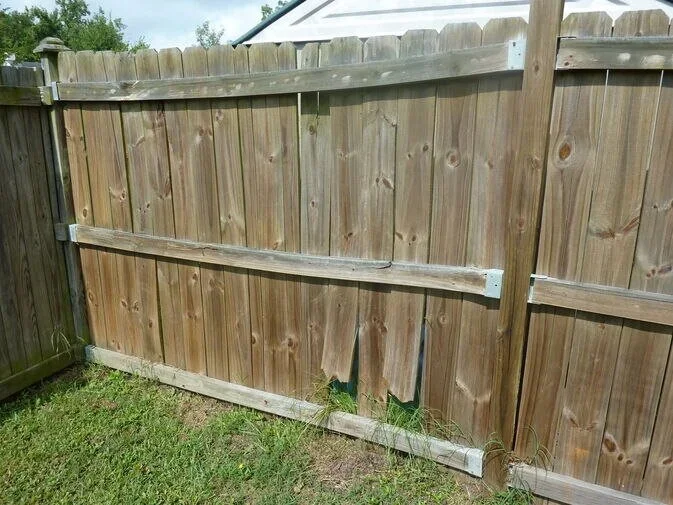
Pressure-treated pine is the most commonly used fence board material in Nashville and across most of the southeastern United States, primarily because it is the most economical option. Pine fence boards are a harder wood and resist rot well — but they are significantly more prone to warping, twisting, shrinking, and cracking than cedar, especially in the first year after installation. Small installation details (correct nails, proper rail spacing, delayed sealing) are essential to minimize movement in pine boards. Even with best practices, pine will move noticeably over time.
Western Red Cedar
Western Red Cedar is the preferred choice for homeowners who prioritize dimensional stability and appearance over material cost. Cedar's natural oils give it superior resistance to moisture absorption, which is the root cause of most fence board warping. Cedar boards stay more dimensionally stable, look better for longer, and respond well to staining and sealing when applied at the correct time.
The trade-off is that cedar is a softer wood that rots faster than pressure-treated pine when in sustained ground contact. This is why most Nashville fence installations use cedar pickets with pressure-treated pine posts — a hybrid approach that reduces warping in the visible fence face while maximizing post lifespan below grade.
Cedar posts are available for a full-cedar installation. When installing cedar posts, the cut bottom end should be coated with asphalt or end-grain sealer before setting, and the post hole must drain well to avoid standing water around the base.
Important: In a cedar-pine combination fence, any component made from pine — including rails or posts — is still subject to the warping, twisting, and movement behavior of pine. Only the cedar pickets benefit from cedar's dimensional stability.
Cedar gates require a metal Z-brace on the back face to maintain square alignment over time. Without internal metal framing, the unsupported weight and seasonal wood movement in cedar gate boards will cause the gate to rack and sag against the hinge alignment.
Composite and PVC fence boards: warp-free alternatives
Composite fence boards and PVC (vinyl) fencing are the two primary alternatives for homeowners who want to eliminate warping entirely.
• Composite fence boards—made from a mixture of wood fibers and recycled plastic—do not absorb moisture and will not cup, bow, or twist. They are significantly more dimensionally stable than any natural wood option.
• PVC fence boards are 100% plastic and are similarly warp-proof. They require no staining, sealing, or treatment of any kind.
• Both materials cost more upfront than wood—typically 20 to 50% higher installed—and carry longer manufacturer warranties. The trade-off is that composite and PVC boards cannot be stained to match natural wood tones and may expand or contract slightly in extreme temperature ranges.
How To Prevent Fence Boards From Warping: Summary Checklist
The following practices, applied together, offer the best available protection against fence board warping in Nashville's climate:
1. Use ring-shank galvanized or aluminum nails—never smooth-shank or uncoated steel.
2. Set fence posts at one-third depth minimum, plumb, in concrete. Use the correct rail count for fence height.
3. Choose grade A fence boards from a professional fence wholesaler, not mixed-grade stock from a retail store.
4. Allow new boards to acclimate: store boards flat and off the ground for several days before installation, if possible.
5. Leave a 1/8-inch gap between pickets during installation to allow for seasonal expansion without buckling.
6. Install in cooler months when possible so boards dry slowly and evenly.
7. Wait the full recommended time before sealing: 6 to 12 months for pressure-treated pine and 3 to 6 months for cedar.
8. Choose lighter stain colors on sun-exposed fence faces to reduce solar heat absorption.
9. Reseal cedar fences every 2 to 3 years to maintain moisture protection and extend dimensional stability.
Fence board Warping Repair in Nashville TN
K&C Fence Company has installed and repaired wood fences in Nashville, TN, and surrounding Middle Tennessee communities since [year]. If your fence boards are warping, cupping, or pulling away from the rails, or you are planning a new fence installation and want to avoid these problems from the start, we offer free on-site inspections and repair estimates.
We serve Nashville, Brentwood, Franklin, Hendersonville, Mount Juliet, and surrounding areas.
Contact K&C Fence Company to schedule a no-cost inspection of your existing fence or a planning consultation for a new installation. It is your investment and our reputation.